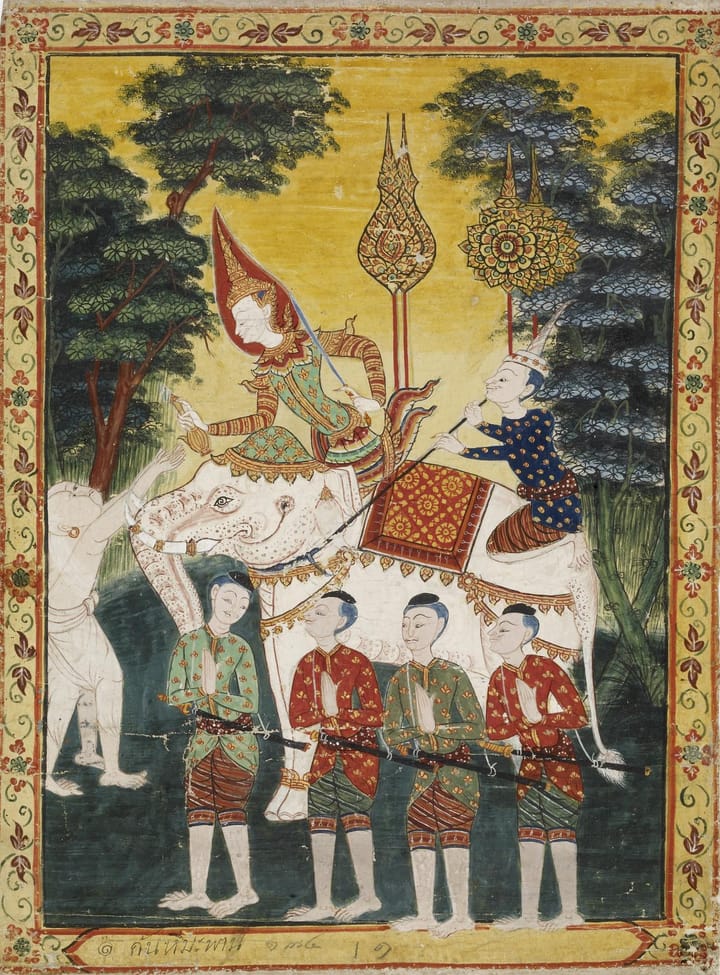
Buddhism DN 15 · The Great Causes Discourse (Mahā Nidāna Sutta) Gives a deep analysis of dependent co-arising and not-self, tracing causation from aging-and-death back through consciousness and name-and-form.
Buddhism AN 1:50 · Luminous (Pabhassara Suttas) Aṅguttara Nikāya · AN 1:50. Translated by Ṭhānissaro Bhikkhu.
Buddhism SN 1:9 · Fond of Conceit (Manakāma Sutta) Saṁyutta Nikāya · SN 1:9. Translated by Ṭhānissaro Bhikkhu.
Buddhism Khp 4 · Sāmaṇera Pañhā — The Novice’s Questions Khuddakapāṭha · Khp 4. Translated by Ṭhānissaro Bhikkhu.
Buddhism Dhp 04 · Blossoms The body's impermanence likened to foam and a mirage, and death's swift claim on those absorbed only in gathering sensual pleasures.
Buddhism MN 6 · If One Would Wish (Ākaṅkheyya Sutta) Lists aspirations a monk might hold—respect, requisites, supernormal attainments—showing how virtue, concentration, and insight fulfill each one.
Buddhism DN 12 · To Lohicca (Lohicca Sutta) Refutes the view that a teacher who has found truth should keep it to himself, distinguishing worthy teachers from unworthy ones.
Buddhism AN 1:49 · Quick to Reverse Itself (Lahu-parivaṭṭa Sutta) Aṅguttara Nikāya · AN 1:49. Translated by Ṭhānissaro Bhikkhu.
Buddhism SN 1:8 · Thoroughly Confused (Susammuṭṭha Sutta) Saṁyutta Nikāya · SN 1:8. Translated by Ṭhānissaro Bhikkhu.
Buddhism Khp 3 · Dvattiṁsākāra — The 32 Parts Khuddakapāṭha · Khp 3. Translated by Ṭhānissaro Bhikkhu.
Buddhism Thag 1:3 · Kaṅkhā (Doubting) Revata Theragāthā · Thag 1:3. Translated by Ṭhānissaro Bhikkhu.